Category: Basics
Not approvedInvestigational
Retatrutide mechanism of action: how retatrutide works on three receptors
One injected peptide that switches on three hormone receptors: GLP-1, GIP and glucagon. Here is what each one does, why the glucagon part is new, and what the early studies measured.
Published Last checked By The Retatrutide File desk
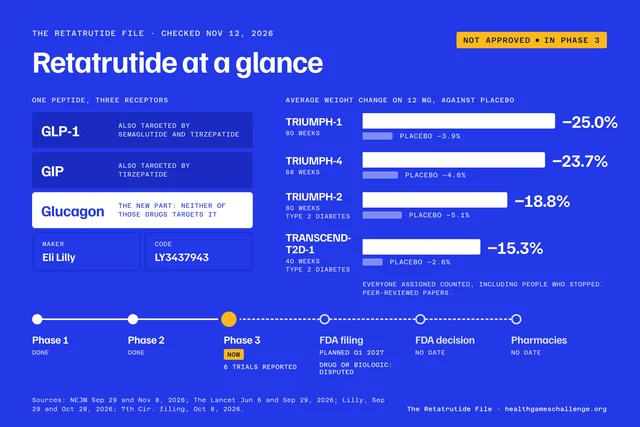
Where retatrutide stands, as of Nov 12, 2026
- Completed: Phase 1 Done
- Completed: Phase 2 Done
- Current stage: Phase 3 Under way
- Next step, not reached: FDA filing Planned Q1 2027
- Not reached: FDA decision No date
- Not reached: Pharmacies No date
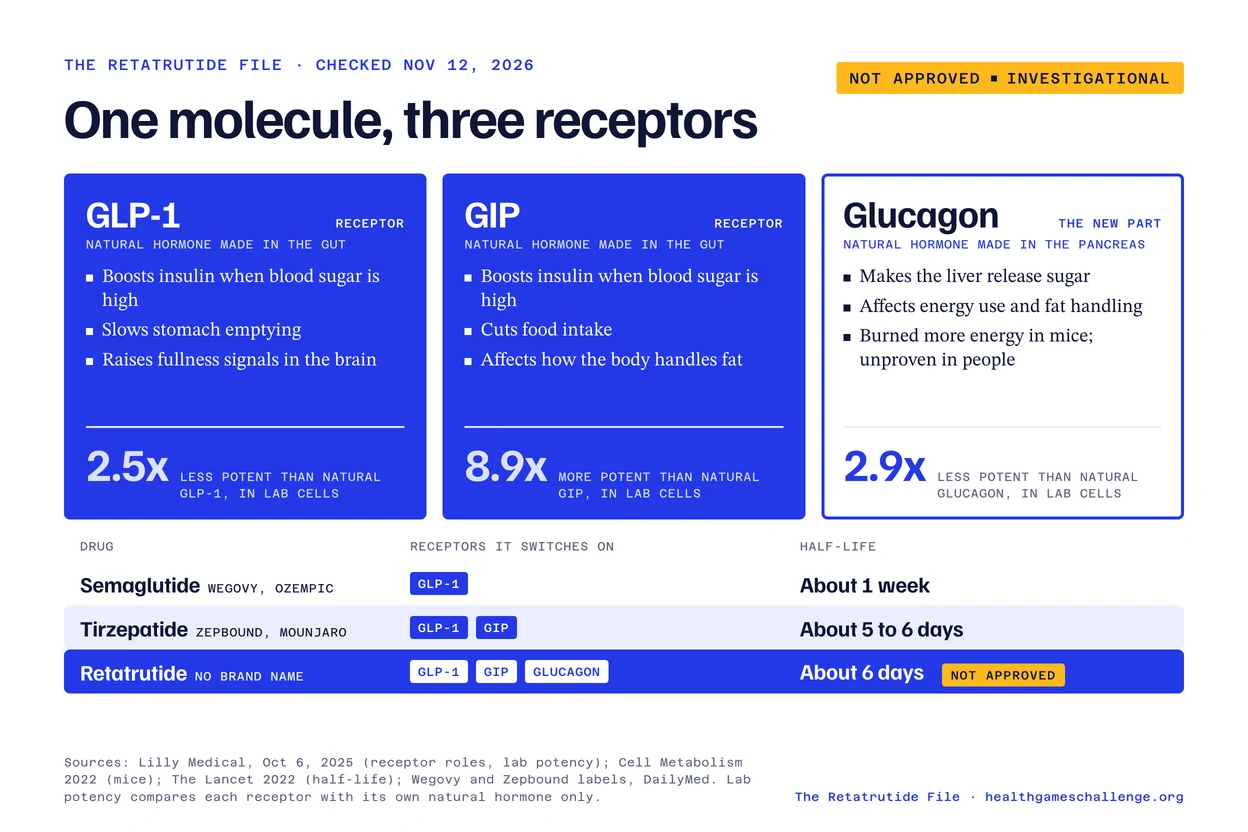
Retatrutide's mechanism of action fits in one sentence. It is a single injected peptide that switches on three hormone receptors at once: the receptors for GLP-1, GIP and glucagon [Lilly, Oct 28, 2026]. Retatrutide is not approved by the FDA or any other regulator, and it is still being tested [Lilly, Oct 28, 2026]. In trials it is given as an injection under the skin once a week [Lilly, Oct 2026].
So how does retatrutide work in the body? Lilly's summary is that early data suggest it may reduce food intake; enhance energy expenditure; improve lipid metabolism and glucose homeostasis; and reduce inflammation
[Lilly Medical, Oct 6, 2025]. In plain words: people eat less, blood sugar control improves, and the body may handle fat differently. Below, we explain how retatrutide works receptor by receptor, with a note on what is proven in people and what was seen only in animals. For the drug as a whole, see what is retatrutide.
What do the GLP-1, GIP and glucagon receptors each do?
A receptor is a docking site on a cell. When the right hormone fits into it, the cell changes what it's doing. Your body makes all three of these hormones around meals [Lilly Medical, Oct 6, 2025]. Retatrutide imitates all three, and an added fatty acid chain keeps it working for days, as explained below [Lilly Medical, Oct 6, 2025].
- GLP-1 is made in the gut. It boosts insulin when blood sugar is high, slows how fast the stomach empties, and sends fullness signals to the brain [Lilly Medical, Oct 6, 2025]. This is the receptor semaglutide (Wegovy, Ozempic) works on [Wegovy label, Jun 2026].
- GIP is also made in the gut. Its main job is boosting insulin when blood sugar is high. It also cuts food intake and helps regulate how the body handles fat [Lilly Medical, Oct 6, 2025]. Tirzepatide (Zepbound, Mounjaro) works on this receptor and GLP-1 [Zepbound label, Aug 2026].
- Glucagon is made in the pancreas. It is best known for making the liver release sugar when blood sugar runs low. It also affects energy use and fat handling [Lilly Medical, Oct 6, 2025]. Neither semaglutide nor tirzepatide targets it.
Retatrutide doesn't hit all three equally. In tests on human receptors in lab cells, it was 8.9 times as potent as natural GIP at the GIP receptor. It was 2.5 times less potent than natural GLP-1 at the GLP-1 receptor, and 2.9 times less potent than natural glucagon at its receptor [Lilly Medical, Oct 6, 2025]. Lilly's discovery paper describes the same balance [Cell Metabolism, 2022]. A 2026 review warns that these lab numbers compare each receptor with its own hormone. They shouldn't be compared across receptors [Pharmaceutics review, 2026].
Why add glucagon to a weight-loss drug?
The glucagon part is what makes retatrutide new. The idea comes from animal work. In obese mice, Lilly's scientists found that weight loss was augmented by the addition of GCGR-mediated increases in energy expenditure to GIPR- and GLP-1R-driven calorie intake reduction
[Cell Metabolism, 2022]. Put simply: the GLP-1 and GIP parts made the mice eat less, and the glucagon part made them burn more.
Whether that happens in people is not yet known. Lilly ran a study in 85 people with obesity measuring calories eaten and burned, finished in August 2025. No results were posted as of Nov 12, 2026 [ClinicalTrials.gov, NCT06313528]. A 2026 review says human studies do not establish the fraction attributable to thermogenesis or to each receptor
[Pharmaceutics review, 2026]. Thermogenesis means burning energy as heat.
The clearest human finding linked to this idea is in the liver, where glucagon signaling affects how fat is handled [Pharmaceutics review, 2026]. Researchers measured liver fat with MRI scans in 98 people from the phase 2 obesity trial. After 24 weeks on 12 mg, liver fat fell by 82.4% on average, compared with a 0.3% rise on placebo. And 86% of people on 12 mg reached normal liver fat, compared with none on placebo [Nature Medicine, 2024]. That's a peer-reviewed result, but the review notes it shows less liver fat with the drug, rather than proof of an isolated glucagon receptor effect
[Pharmaceutics review, 2026]. The paper also found that liver fat fell more in people who lost more weight [Nature Medicine, 2024]. The retatrutide benefits guide covers the liver results in full.
What safety questions does the glucagon part raise?
Two, mainly: blood sugar and heart rate.
Blood sugar. On its own, glucagon pushes blood sugar up. The bet behind a triple agonist is that the GLP-1 and GIP effects, which raise insulin, more than cancel that out [Pharmaceutics review, 2026]. So far, the trials back that up. In TRANSCEND-T2D-1, a peer-reviewed phase 3 trial in type 2 diabetes, A1C fell by 1.94 percentage points on 12 mg over 40 weeks, compared with 0.81 on placebo. A1C is a measure of average blood sugar. The paper adds: No severe hypoglycaemia was reported.
[Lancet, Jun 6, 2026] The phase 2 diabetes trial also had no reports of severe low blood sugar [Lancet, 2023].
Heart rate. In the phase 2 obesity trial, Dose-dependent increases in heart rate peaked at 24 weeks and declined thereafter
[NEJM, 2023]. The trial summary doesn't give the size of the rise, and we found no primary source that does. Nor is it clear the glucagon part is to blame: the review calls that link uncertain
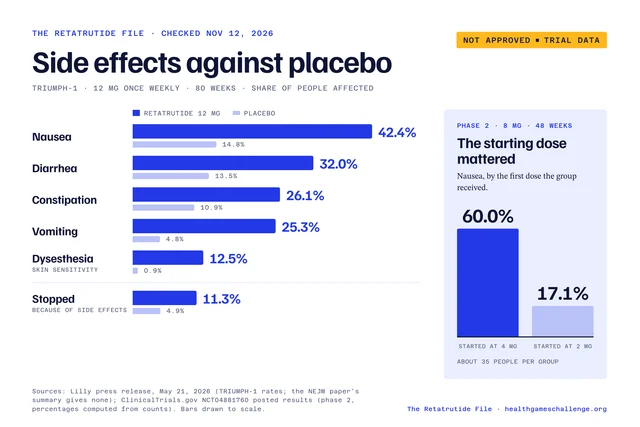
[Pharmaceutics review, 2026]. For comparison, the approved drugs' labels report average rises of 1 to 3 beats per minute for Zepbound [Zepbound label, Aug 2026] and 1 to 4 for Wegovy [Wegovy label, Jun 2026]. The retatrutide side effects guide has the trial-by-trial safety data.
How is retatrutide different from semaglutide and tirzepatide?
The short version is one, two, three. Semaglutide acts on one receptor, tirzepatide on two, and retatrutide on three.
| Drug (brand) | Receptors it switches on | Half-life | Status, Nov 12, 2026 |
|---|---|---|---|
| Semaglutide (Wegovy, Ozempic) | GLP-1 | About 1 week [Wegovy label, Jun 2026] | Approved |
| Tirzepatide (Zepbound, Mounjaro) | GLP-1, GIP | About 5 to 6 days [Zepbound label, Aug 2026] | Approved |
| Retatrutide (no brand name) | GLP-1, GIP, glucagon | About 6 days [Lancet, 2022] | Not approved [Lilly, Oct 28, 2026] |
Tirzepatide and retatrutide are built in a similar way. Each is a chain of amino acids with a fatty acid chain attached, which helps it stay in the blood longer [Zepbound label, Aug 2026] [Lilly Medical, Oct 6, 2025]. The difference is that retatrutide also reaches the glucagon receptor.
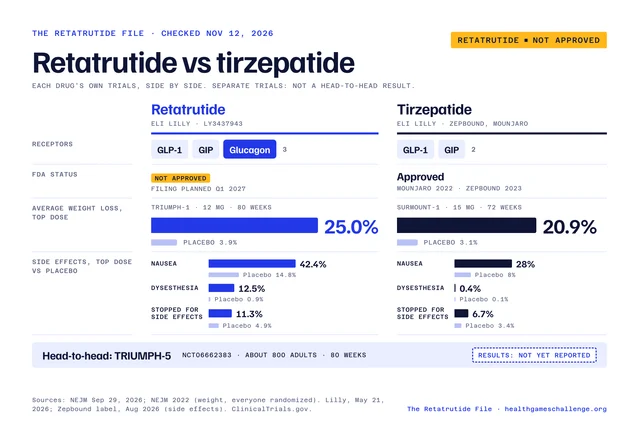
More receptors doesn't automatically mean a better drug. One head-to-head trial has reported. In TRANSCEND-T2D-2, adults with type 2 diabetes lost more weight on retatrutide than on semaglutide 2 mg. That result comes from Lilly's press release and is not yet peer reviewed [Lilly, Oct 28, 2026]. No result against tirzepatide exists yet. The comparison guides, retatrutide vs tirzepatide and retatrutide vs semaglutide, set the trial numbers side by side.
What is retatrutide's half-life, and why is it given weekly?
A drug's half-life is the time it takes for half of it to leave the blood. For retatrutide it's about 6 days. A 12-week phase 1b study tested it in 72 people with type 2 diabetes. It found that its half-life was approximately 6 days
, and the authors said this suits once-weekly dosing [Lancet, 2022]. Lilly's medical team adds that blood levels peak 12 to 72 hours after an injection [Lilly Medical, Oct 6, 2025].
The long half-life comes from that fatty acid chain. It lets the drug cling to albumin, a common protein in the blood, which slows its removal [Lilly Medical, Oct 6, 2025]. The effect showed up early: in the first human study, a drop in body weight persisted up to day 43 after a single dose
[Cell Metabolism, 2022]. Trial doses and schedules are covered, as facts about the trials, in retatrutide dosage in trials.
What did the early human studies measure?
The first study gave a single injection to 45 healthy volunteers in 2019. It looked mainly at safety and how the body processes the drug [ClinicalTrials.gov, NCT03841630]. The Cell Metabolism paper reported a safety profile similar to other incretins
, the hormone family GLP-1 and GIP belong to [Cell Metabolism, 2022].
The phase 1b study followed in people with type 2 diabetes. Over 12 weeks it measured safety, blood levels, blood sugar and weight. At the three highest doses, A1C fell by 1.2 to 1.6 percentage points more than on placebo. Weight fell by up to 8.96 kg more than on placebo, in the group that stepped up to the highest dose [Lancet, 2022]. Stomach and gut side effects were the most common [Lancet, 2022]. Those results set up the phase 2 and phase 3 trials.
Is retatrutide a GLP-1, a peptide, a steroid or a biologic?
Is retatrutide a GLP-1? Partly. It acts on the GLP-1 receptor, but on two others too. Lilly calls it a "triple agonist" and says the nickname "GLP-3" is a scientifically inaccurate label
[Lilly, Oct 2026].
Is it a peptide? Yes. It's a chain of amino acids with a fatty acid chain attached [Lilly Medical, Oct 6, 2025]. The main chain has 39 amino acids [Pharmaceutics review, 2026]; the exact total depends on how the side chain is counted, as the biologic question below shows. In trials it is injected [Lilly, Oct 2026], and we found no trial of a pill version.
Is it a steroid? No. Every source describes a peptide that works through hormone receptors [Lilly Medical, Oct 6, 2025] [Pharmaceutics review, 2026]. Steroids are a different kind of molecule, and no source we read links retatrutide to them.
Is it a biologic? This is disputed. Lilly plans to file a Biologics License Application in Q1 2027 [Lilly, Sep 29, 2026]. But in March 2024 the FDA classified retatrutide as a drug, not a biological product [7th Cir. brief, Apr 1, 2026]. The fight turns on a counting rule. Under FDA rules, a protein must be greater than 40 amino acids in size
. Retatrutide's main chain has 39 amino acids, and the side chain that holds its fatty acid adds two more. Lilly counts 41. The FDA counted only 40, because it says only alpha amino acids count, and one side-chain unit is not that type [7th Cir. brief, Apr 1, 2026]. That's why a 2026 review calls retatrutide a 39-amino-acid peptide: it counts the main chain only [Pharmaceutics review, 2026]. A court sent part of the question back to the FDA, which again rejected Lilly's view on Oct 2, 2026. Lilly is appealing, and told the court it needs to know which pathway to use when it files [7th Cir. filing, Oct 8, 2026]. We found no ruling as of Nov 12, 2026. The retatrutide FDA approval guide explains what this could mean for timing.
The classification doesn't change how the molecule works. It changes which rulebook the FDA uses to review it.
Where can you get it?
Only through a clinical trial or Lilly's expanded access program. No one can legally sell it, as the retatrutide for sale guide explains.
Sources
- [Lilly, Oct 28, 2026] Lilly's retatrutide delivered greater A1C reduction and more than double the weight loss of Ozempic's highest approved dose in head-to-head trial. Eli Lilly and Company press release, PR Newswire copy (investor.lilly.com blocks automated reading), Oct 28, 2026. Company press release. Checked Nov 12, 2026
- [Lilly, Oct 2026] What to know about retatrutide. Eli Lilly and Company (page marked last updated October 2026), Oct 2026. Company page. Checked Nov 12, 2026
- [Lilly Medical, Oct 6, 2025] What is the mechanism of action of retatrutide?. Lilly Medical (US medical information), date of last review Oct 6, 2025, Oct 6, 2025. Company page (medical information). Checked Nov 12, 2026
- [Cell Metabolism, 2022] LY3437943, a novel triple glucagon, GIP, and GLP-1 receptor agonist for glycemic control and weight loss: From discovery to clinical proof of concept. Cell Metabolism (Coskun T et al., Eli Lilly), Aug 18, 2022. Peer-reviewed paper (lab, animal and first human data). Checked Nov 12, 2026
- [ClinicalTrials.gov, NCT03841630] A Safety Study of LY3437943 Given as a Single Injection in Healthy Participants. ClinicalTrials.gov, sponsor Eli Lilly and Company, Mar 13, 2019. Trial registry record. Date shown is the study start. 45 participants; completed Jul 25, 2019. Checked Nov 12, 2026
- [Lancet, 2022] LY3437943, a novel triple GIP, GLP-1, and glucagon receptor agonist in people with type 2 diabetes: a phase 1b, multicentre, double-blind, placebo-controlled, randomised, multiple-ascending dose trial. The Lancet (Urva S et al.), Oct 27, 2022. Peer-reviewed paper. Checked Nov 12, 2026
- [NEJM, 2023] Triple-Hormone-Receptor Agonist Retatrutide for Obesity: A Phase 2 Trial. New England Journal of Medicine (Jastreboff AM et al.), Jun 26, 2023. Peer-reviewed paper. Checked Nov 12, 2026
- [Lancet, 2023] Retatrutide, a GIP, GLP-1 and glucagon receptor agonist, for people with type 2 diabetes: a randomised, double-blind, placebo and active-controlled, parallel-group, phase 2 trial conducted in the USA. The Lancet (Rosenstock J et al.), Jun 26, 2023. Peer-reviewed paper. Checked Nov 12, 2026
- [Nature Medicine, 2024] Triple hormone receptor agonist retatrutide for metabolic dysfunction-associated steatotic liver disease: a randomized phase 2a trial. Nature Medicine (Sanyal AJ et al.), Jun 10, 2024. Peer-reviewed paper (substudy of the phase 2 obesity trial). Checked Nov 12, 2026
- [Lancet, Jun 6, 2026] Efficacy and safety of retatrutide, a GIP, GLP-1, and glucagon receptor agonist, in people with type 2 diabetes and inadequate glycaemic control with diet and exercise (TRANSCEND-T2D-1): a double-blind, randomised, phase 3 trial. The Lancet (Bajaj HS et al.), Jun 6, 2026. Peer-reviewed paper. Checked Nov 12, 2026
- [Pharmaceutics review, 2026] Retatrutide as a Unimolecular GIP/GLP-1/Glucagon Receptor Tri-Agonist: Molecular Design, Pharmaceutical Development and Critical Interpretation of Emerging Phase 3 Evidence. Pharmaceutics 2026;18(10):1277 (Mateescu DM et al.), Oct 2026. Peer-reviewed review article (secondary source). Checked Nov 12, 2026
- [ClinicalTrials.gov, NCT06313528] A Study to Measure Calorie Consumption and Usage in Participants With Obesity Using LY3437943. ClinicalTrials.gov, sponsor Eli Lilly and Company, Aug 26, 2025. Trial registry record. Date shown is the completion date. 85 participants; no results posted as of Nov 12, 2026. Checked Nov 12, 2026
- [Zepbound label, Aug 2026] ZEPBOUND (tirzepatide) injection, prescribing information (revised 08/2026). DailyMed, U.S. National Library of Medicine, Aug 2026. Regulator (drug label). Checked Nov 12, 2026
- [Wegovy label, Jun 2026] WEGOVY (semaglutide) injection and tablets, prescribing information. DailyMed, U.S. National Library of Medicine (label version published Jun 30, 2026), Jun 30, 2026. Regulator (drug label). Checked Nov 12, 2026
- [Lilly, Sep 29, 2026] Lilly's triple agonist, retatrutide, delivered substantial weight loss and A1C reduction, underscoring its potential promise for people with obesity and type 2 diabetes. Eli Lilly and Company press release, PR Newswire, Sep 29, 2026. Company press release. Checked Nov 12, 2026
- [7th Cir. brief, Apr 1, 2026] Eli Lilly and Company v. Kennedy, No. 26-1301, Brief of Plaintiff-Appellant (Dkt. 12). U.S. Court of Appeals for the Seventh Circuit, RECAP copy via CourtListener, Apr 1, 2026. Court record (filed by Lilly). Checked Nov 12, 2026
- [7th Cir. filing, Oct 8, 2026] Eli Lilly and Company v. Kennedy, No. 26-1301, Supplemental Brief of Appellant (Dkt. 47). U.S. Court of Appeals for the Seventh Circuit, RECAP copy via CourtListener, Oct 8, 2026. Court record (filed by Lilly). We found no decision in the appeal as of Nov 12, 2026. Checked Nov 12, 2026
Changes to this page
- Published. Mechanism sources, half-life, trial findings and the drug-or-biologic dispute checked on this date.