Category: Safety
Not approvedInvestigational
Retatrutide dosage: the doses trials tested, and why none is approved
No regulator has approved retatrutide, so no approved dose exists. This page reports what the trials tested, as facts about those trials. It is not a guide to taking anything.
Published Last checked By The Retatrutide File desk
Where retatrutide stands, as of Nov 12, 2026
- Completed: Phase 1 Done
- Completed: Phase 2 Done
- Current stage: Phase 3 Under way
- Next step, not reached: FDA filing Planned Q1 2027
- Not reached: FDA decision No date
- Not reached: Pharmacies No date
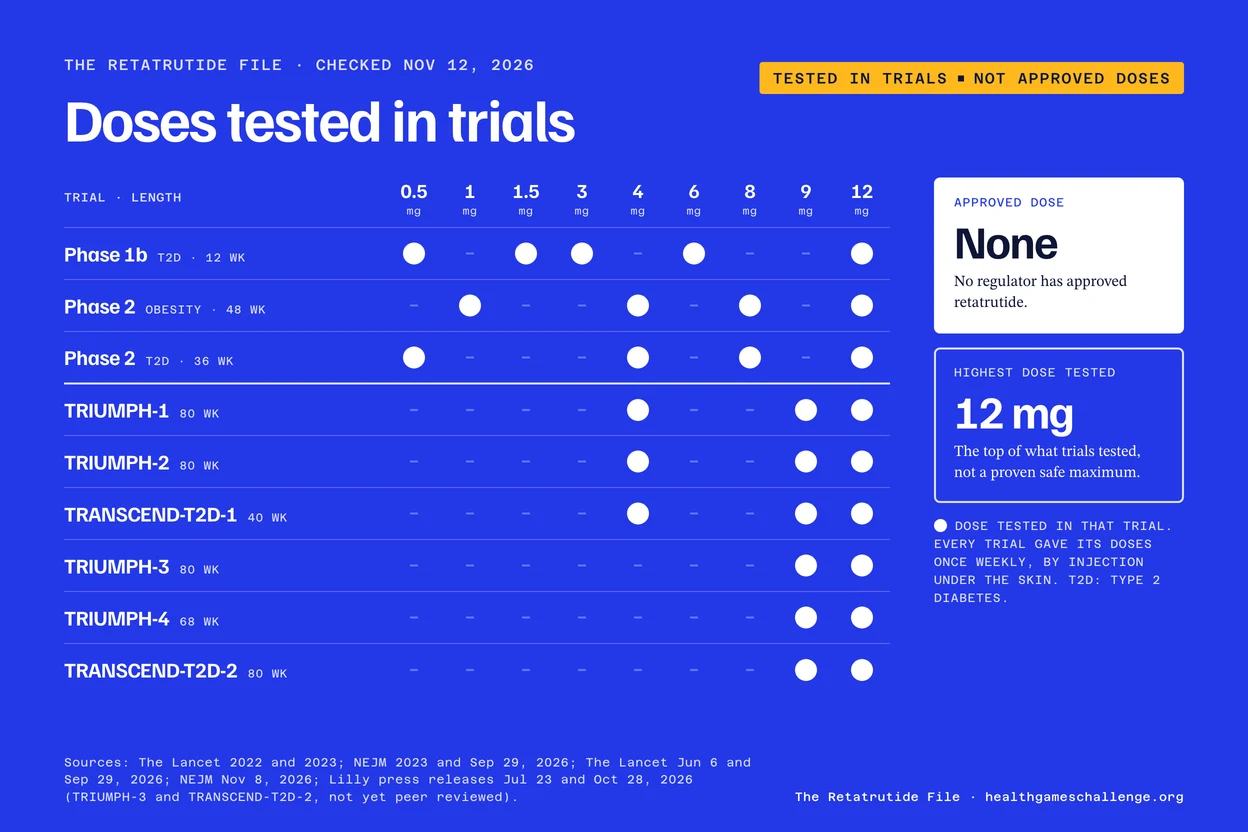
There is no approved retatrutide dosage. Retatrutide is not approved by the FDA or any other regulator, and it is not on the market [Lilly, Oct 2026]. An approved dose only exists once a regulator reviews the evidence and prints it on a drug label. What does exist is a record of the doses Lilly's trials tested, how those trials raised the dose and what happened at each level.
That record is what this page reports, as facts about the trials. It is not a dosing guide, and nothing here tells anyone what to take. Every figure carries its source, with the source type labeled.
Is there an approved retatrutide dosage?
No. In trials, retatrutide is taken as a once-weekly subcutaneous injection
, which means a shot under the skin [Lilly, Oct 2026]. The dose each volunteer received was set by the trial's protocol and assigned at random. In the TRIUMPH-2 trial, volunteers gave themselves the weekly injections [Lancet, Sep 29, 2026].
So a "retatrutide dosage chart" can only be a chart of what researchers tested. It can't tell anyone outside a trial what a safe or useful dose would be.
What doses did the trials test?
Here is every trial with published or announced results, with the doses it tested. All doses were given once a week by injection under the skin. This table records what each trial tested. It is not a dosage chart.
| Trial | Who was in it | Doses tested | How the dose was reached | Length | Source type |
|---|---|---|---|---|---|
| Phase 1b | 72 adults with type 2 diabetes | 0.5, 1.5, 3, 6 and 12 mg | The top doses in the two highest groups were reached in steps (3 to 6 mg; 3 to 6, 9 and 12 mg) | 12 weeks | Peer-reviewed paper [Lancet, 2022] |
| Phase 2, obesity | 338 adults with obesity or overweight | 1, 4, 8 and 12 mg | 1 mg with no step-up. 4 mg and 8 mg each had one arm starting at 2 mg and one at 4 mg; 12 mg started at 2 mg | 48 weeks | Peer-reviewed paper [NEJM, 2023] [ClinicalTrials.gov, NCT04881760] |
| Phase 2, type 2 diabetes | 281 adults with type 2 diabetes | 0.5, 4, 8 and 12 mg | 4 mg with and without a step-up; 8 mg started at 2 mg or 4 mg; 12 mg started at 2 mg | 36 weeks | Peer-reviewed paper [Lancet, 2023] |
| Phase 2b, kidney function | 146 adults with obesity and kidney disease | Target 12 mg | Started at 2 mg, raised every 4 weeks; people could stay at 4, 6 or 9 mg if 12 mg wasn't tolerated | 24 weeks | Registry results, not peer reviewed [ClinicalTrials.gov, NCT05936151] |
| TRIUMPH-1 | 2,339 adults with obesity, no diabetes | 4, 9 and 12 mg | Started at 2 mg, raised every 4 weeks | 80 weeks | Peer-reviewed paper and press release [NEJM, Sep 29, 2026] [Lilly, May 21, 2026] |
| TRIUMPH-2 | 1,152 adults with obesity and type 2 diabetes | 4, 9 and 12 mg | Started at 2 mg, raised every 4 weeks | 80 weeks | Peer-reviewed paper and press release [Lancet, Sep 29, 2026] [Lilly, Jul 23, 2026] |
| TRIUMPH-3 | 1,949 adults with severe obesity and heart disease | 9 and 12 mg | Started at 2 mg, raised every 4 weeks | 80 weeks | Press release, not yet peer reviewed [Lilly, Jul 23, 2026] |
| TRIUMPH-4 | 445 adults with obesity and knee osteoarthritis | 9 and 12 mg | Started at 2 mg, raised every 4 weeks | 68 weeks | Peer-reviewed paper and press release [NEJM, Nov 8, 2026] [Lilly, Dec 11, 2025] |
| TRANSCEND-T2D-1 | 537 adults with type 2 diabetes | 4, 9 and 12 mg | Started at 2 mg, raised every 4 weeks | 40 weeks | Peer-reviewed paper and press release [Lancet, Jun 6, 2026] [Lilly, Mar 19, 2026] |
| TRANSCEND-T2D-2 | 1,298 adults with type 2 diabetes, against semaglutide 2 mg | 9 and 12 mg | Started at 2 mg, raised every 4 weeks | 80 weeks | Press release, not yet peer reviewed [Lilly, Oct 28, 2026] |
The phase 2 sources we could read list each arm's steps but not how many weeks each step lasted [ClinicalTrials.gov, NCT04881760]. The phase 2 diabetes authors wrote that those results informed dose selection for the phase 3 programme
[Lancet, 2023].
Retatrutide dosing schedule: how phase 3 stepped the dose up
The phase 3 trials all used the same pattern. Lilly describes it this way: The TRIUMPH clinical trial program includes five doses of retatrutide: 2 mg, 4 mg, 6 mg, 9 mg and 12 mg.
It adds that volunteers began on 2 mg once weekly and increased the dose every four weeks until reaching their target dose
[Lilly, Dec 11, 2025].
In TRIUMPH-1, Lilly spelled out each path. The 4 mg group got there via one step at 2 mg
. The 9 mg group went via steps at 2 mg, 4 mg and 6 mg
. The 12 mg group went via steps at 2 mg, 4 mg, 6 mg and 9 mg
[Lilly, May 21, 2026]. The trial design paper describes the 80-week trials as 16 weeks of dose escalation followed by 64 weeks at the assigned dose [DOM, Oct 15, 2025].
Three more details matter for reading the results:
- Blinding. Doses were reached through
a fixed dose escalation regimen
, and neither volunteers nor staff knew who got which dose [DOM, Oct 15, 2025]. - Dose cuts were allowed. A permanent reduction was
permitted for management of gastrointestinal adverse events or inadequate oral intake
that other steps hadn't fixed. It was also allowed for people who reached a BMI of 22 or lower, or felt they had lost too much weight [DOM, Oct 15, 2025]. - Some trials aimed for the most each person could tolerate. The TRIUMPH-1 extension used
a maximum tolerated dose of 9 mg or 12 mg
[Lilly, May 21, 2026]. The 10,000-person outcomes trial gives escalated dosesup to a maximum tolerated dose
[ClinicalTrials.gov, NCT06383390].
What about "retatrutide dosage per week"? In every trial above, the dose a group was assigned was given as one injection a week.
Why did the trials raise the dose in steps?
The trial design paper gives the reason in one sentence. The doses and the escalation were selected based on safety and efficacy data as well as exposure‐response modelling from phase 1 and 2 retatrutide studies
[DOM, Oct 15, 2025]. Exposure-response modelling means estimating how the amount of drug in the blood relates to its effects and side effects. The phase 2 starting-dose results in the next section are part of that evidence.
The once-a-week rhythm also comes from early work. In the 12-week phase 1b study, the drug's half-life was about 6 days. In other words, the level in the blood fell by half roughly every six days. The authors wrote that its pharmacokinetics suggest suitability for once-weekly dosing
[Lancet, 2022]. How the drug acts on its three receptors is explained in how retatrutide works.
What happened when trials started lower?
The phase 2 obesity trial is the one that tested starting doses directly. Some groups began at 2 mg, others at 4 mg. The paper found that the gut side effects were partially mitigated with a lower starting dose (2 mg vs. 4 mg)
[NEJM, 2023].
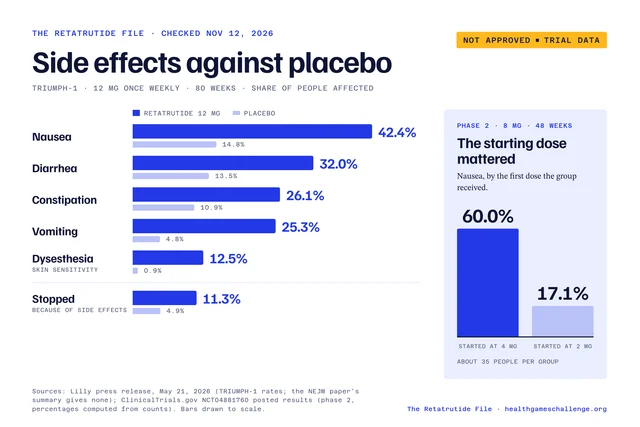
The registry's posted counts show the size of the difference. For the 8 mg groups, nausea affected 60.0% of people whose first dose was 4 mg, against 17.1% of those whose first dose was 2 mg. Vomiting affected 25.7% against 5.7%. For 4 mg, nausea affected 36.4% without a step-up and 18.2% with one [ClinicalTrials.gov, NCT04881760]. On placebo, it was 11.4%. Each group held only about 35 people, so these numbers are rough.
The phase 2 diabetes trial pointed the same way. Gut side effects ranged from 13% on 0.5 mg up to 50% in the 8 mg fast escalation group
[Lancet, 2023]. In phase 3, Lilly said the most common gut side effects in TRANSCEND-T2D-1 occurred primarily during dose escalation
[Lilly, Mar 19, 2026]. The full side-effect picture is in retatrutide side effects.
Did higher doses lose more weight?
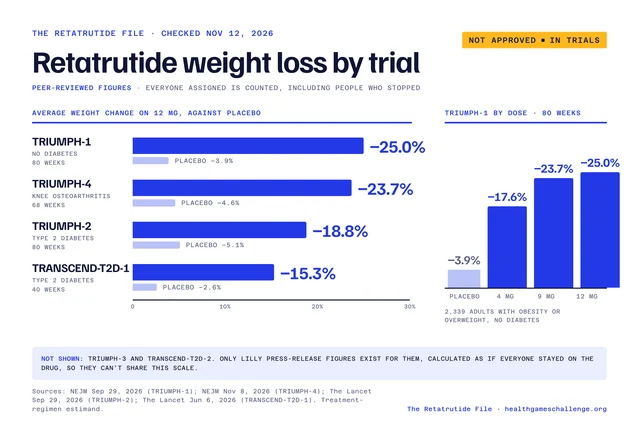
Yes, but with more dropouts. In TRIUMPH-1's peer-reviewed paper, average weight change over 80 weeks was −17.6% on 4 mg, −23.7% on 9 mg and −25.0% on 12 mg. On placebo it was −3.9% [NEJM, Sep 29, 2026]. Those figures count everyone assigned to each dose, including people who stopped.
Dropouts rose the other way. Side effects led 4.1% of people on 4 mg to stop, 6.9% on 9 mg and 11.3% on 12 mg, against 4.9% on placebo [Lilly, May 21, 2026]. Lilly pointed out that the 4 mg dose was reached with only a single escalation step
and had a lower dropout rate than placebo [Lilly, May 21, 2026]. The pattern isn't always tidy. In TRIUMPH-2, more people stopped on 9 mg (12%) than on 12 mg (8%) [Lancet, Sep 29, 2026]. Trial-by-trial weight results are in retatrutide weight loss results.
What is the retatrutide max dose?
The highest dose tested in any trial that has reported is 12 mg once a week [NEJM, Sep 29, 2026] [Lilly, Dec 11, 2025]. That is the top of what researchers chose to test. It is not a proven safe maximum, and no regulator has set one. Some volunteers on 12 mg stopped the drug because of side effects, as the dropout figures above show.
Why there's no retatrutide dosage chart, calculator or units guide here
People who search for a dosage chart, a "starting dose" or syringe units are usually looking at a vial bought online. Those products are not Lilly's trial drug, and no one has checked what is inside them. The FDA says sellers have labeled retatrutide "for research purposes" while selling it directly to consumers for human use with dosing instructions
[FDA, Oct 1, 2026]. Retatrutide also cannot be used in compounding under federal law
, so no pharmacy can legally prepare it [FDA, Oct 1, 2026].
What's on a vial's label may not match what's in it. The TGA, Australia's regulator, tested one vial sold as retatrutide. It found undeclared semaglutide and no retatrutide
, at about 8 times the level in approved semaglutide products [TGA, Sep 14, 2026]. The buyer had been hospitalized after uncontrollable vomiting. In Victoria, Australia, health officials have linked six cases of acute liver injury to products labeled retatrutide [Victoria Health, Jun 19, 2026]. A dose worked out from a label like that has nothing to stand on.
Measuring is a hazard of its own. With compounded semaglutide, the FDA has logged patients who administered five to 20 times more than the intended dose
. It cited confusion between different units of measurement (e.g., milliliters, milligrams and “units”)
. Some of those patients needed hospital care [FDA, Jul 26, 2024]. That's why this site gives no conversions, no mixing steps and no calculators. What the online listings are, and why selling them is illegal, is covered in retatrutide for sale.
When will there be a real retatrutide dosage label?
A label would settle the questions trials leave open: the starting dose, the steps, the maintenance doses and the maximum. Approved drugs show what that looks like. The Zepbound label, for example, sets a starting dose for treatment initiation, three maintenance doses and a Maximum Recommended Dosage
of 15 mg once weekly [FDA label, Aug 2026]. The FDA approved those numbers after reviewing Lilly's evidence.
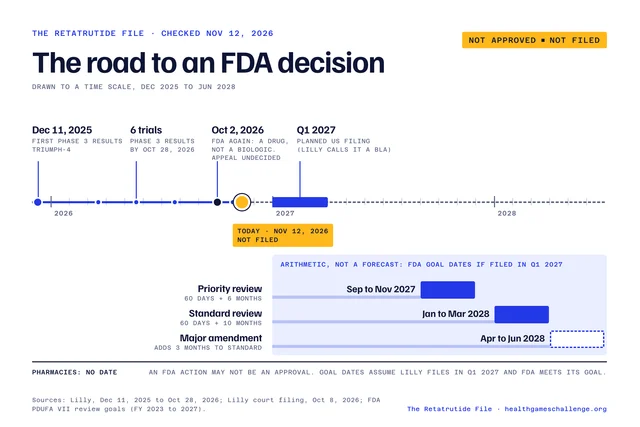
For retatrutide, that review hasn't begun. Lilly says it plans to submit
its application to the FDA in Q1 2027 [Lilly, Sep 29, 2026]. A decision would follow the FDA's review, so no label can exist before then. Lilly also hasn't said which doses it will ask for. Two running trials could shape the answer. TRIUMPH-9 is comparing Different Retatrutide Dose Escalation Schemes
, with main results estimated for October 2028 [ClinicalTrials.gov, NCT07357415]. TRIUMPH-6 is testing what keeps weight off after 80 weeks: staying on the same dose, changing the dose or switching to placebo. Its main results are estimated for April 2028 [ClinicalTrials.gov, NCT06859268].
The timeline is covered in retatrutide FDA approval. For the basics of the drug, start with what is retatrutide.
Sources
- [Lilly, Oct 2026] What to know about retatrutide. Eli Lilly and Company (page marked last updated October 2026), Oct 2026. Company page. Checked Nov 12, 2026
- [Lilly, Dec 11, 2025] Lilly's triple agonist, retatrutide, delivered weight loss of up to an average of 71.2 lbs along with substantial relief from osteoarthritis pain in first successful Phase 3 trial. Eli Lilly and Company press release, PR Newswire copy (investor.lilly.com blocks automated reading), Dec 11, 2025. Company press release. Checked Nov 12, 2026
- [Lilly, Mar 19, 2026] Lilly's triple agonist, retatrutide, demonstrated significant reductions in A1C and weight in first Phase 3 trial for treatment of type 2 diabetes. Eli Lilly and Company press release, PR Newswire copy, Mar 19, 2026. Company press release. Checked Nov 12, 2026
- [Lilly, May 21, 2026] Lilly's triple agonist, retatrutide, delivered powerful weight loss in pivotal Phase 3 obesity trial. Eli Lilly and Company press release, PR Newswire copy, May 21, 2026. Company press release. Checked Nov 12, 2026
- [Lilly, Jul 23, 2026] Lilly's triple agonist, retatrutide, successful in two additional Phase 3 obesity trials, delivering significant improvements in weight and A1C. Eli Lilly and Company press release, PR Newswire copy, Jul 23, 2026. Company press release. Checked Nov 12, 2026
- [Lilly, Sep 29, 2026] Lilly's triple agonist, retatrutide, delivered substantial weight loss and A1C reduction, underscoring its potential promise for people with obesity and type 2 diabetes. Eli Lilly and Company press release, PR Newswire, Sep 29, 2026. Company press release. Checked Nov 12, 2026
- [Lilly, Oct 28, 2026] Lilly's retatrutide delivered greater A1C reduction and more than double the weight loss of Ozempic's highest approved dose in head-to-head trial. Eli Lilly and Company press release, PR Newswire, Oct 28, 2026. Company press release. Checked Nov 12, 2026
- [NEJM, Sep 29, 2026] Retatrutide, a Triple Hormone Receptor Agonist, for Treatment of Obesity (TRIUMPH-1). New England Journal of Medicine (Jastreboff AM et al.), print issue Nov 5, 2026, Sep 29, 2026. Peer-reviewed paper. Abstract read on PubMed. Checked Nov 12, 2026
- [Lancet, Sep 29, 2026] Retatrutide in adults with obesity and type 2 diabetes (TRIUMPH-2): a double-blind, parallel-group, randomised, placebo-controlled, phase 3 trial. The Lancet (Bellido V et al.), Sep 29, 2026. Peer-reviewed paper. Abstract read on PubMed. Checked Nov 12, 2026
- [Lancet, Jun 6, 2026] Efficacy and safety of retatrutide, a GIP, GLP-1, and glucagon receptor agonist, in people with type 2 diabetes and inadequate glycaemic control with diet and exercise (TRANSCEND-T2D-1): a double-blind, randomised, phase 3 trial. The Lancet (Bajaj HS et al.), Jun 6, 2026. Peer-reviewed paper. Abstract read on PubMed. Checked Nov 12, 2026
- [NEJM, Nov 8, 2026] Retatrutide Once Weekly in Adults with Knee Osteoarthritis Pain and Obesity (TRIUMPH-4 and TRIUMPH-1-OA). New England Journal of Medicine (Schnitzer TJ et al.), online ahead of print, Nov 8, 2026. Peer-reviewed paper. Abstract read on PubMed. Checked Nov 12, 2026
- [Lancet, 2022] LY3437943, a novel triple GIP, GLP-1, and glucagon receptor agonist in people with type 2 diabetes: a phase 1b, multicentre, double-blind, placebo-controlled, randomised, multiple-ascending dose trial. The Lancet (Urva S et al.), Oct 27, 2022. Peer-reviewed paper. Abstract read on PubMed. Checked Nov 12, 2026
- [NEJM, 2023] Triple-Hormone-Receptor Agonist Retatrutide for Obesity: A Phase 2 Trial. New England Journal of Medicine (Jastreboff AM et al.), Jun 26, 2023. Peer-reviewed paper. Abstract read on PubMed. Checked Nov 12, 2026
- [ClinicalTrials.gov, NCT04881760] A Study of LY3437943 in Participants Who Have Obesity or Are Overweight (phase 2), posted results. ClinicalTrials.gov, sponsor Eli Lilly and Company (record updated Sep 13, 2023), Sep 13, 2023. Trial registry record with posted results. Percentages on this page are computed by us from the posted counts of people affected and people at risk, up to 52 weeks. Checked Nov 12, 2026
- [Lancet, 2023] Retatrutide, a GIP, GLP-1 and glucagon receptor agonist, for people with type 2 diabetes: a randomised, double-blind, placebo and active-controlled, parallel-group, phase 2 trial conducted in the USA. The Lancet (Rosenstock J et al.), Jun 26, 2023. Peer-reviewed paper. Abstract read on PubMed. Checked Nov 12, 2026
- [ClinicalTrials.gov, NCT05936151] A Phase 2b, Double-Blind Study to Investigate the Effect of Retatrutide on Renal Function in Participants With Overweight or Obesity and Chronic Kidney Disease With or Without Type 2 Diabetes, posted results. ClinicalTrials.gov, sponsor Eli Lilly and Company (record updated Nov 9, 2026), Nov 9, 2026. Trial registry record with posted results (not peer reviewed). Checked Nov 12, 2026
- [DOM, Oct 15, 2025] Retatrutide for the treatment of obesity, obstructive sleep apnea and knee osteoarthritis: Rationale and design of the TRIUMPH registrational clinical trials. Diabetes, Obesity and Metabolism (Giblin K et al.), Oct 15, 2025. Peer-reviewed paper (trial design). Open-access full text on PubMed Central. Checked Nov 12, 2026
- [ClinicalTrials.gov, NCT06383390] The Effect of Retatrutide Once Weekly on Cardiovascular Outcomes and Kidney Outcomes in Adults Living With Obesity. ClinicalTrials.gov, sponsor Eli Lilly and Company (record updated Oct 8, 2026), Oct 8, 2026. Trial registry record. Checked Nov 12, 2026
- [ClinicalTrials.gov, NCT07357415] A Phase 3b Study to Investigate the Efficacy and Safety of Different Retatrutide Dose Escalation Schemes in Participants Without Type 2 Diabetes Who Have Obesity or Overweight (TRIUMPH-9). ClinicalTrials.gov, sponsor Eli Lilly and Company (record updated Jun 9, 2026), Jun 9, 2026. Trial registry record. Checked Nov 12, 2026
- [ClinicalTrials.gov, NCT06859268] A Phase 3b, Randomized, Double-Blind, Placebo-Controlled Study to Evaluate Retatrutide Treatment in the Maintenance of Weight Reduction in Individuals With Obesity (TRIUMPH-6). ClinicalTrials.gov, sponsor Eli Lilly and Company (record updated Mar 3, 2026), Mar 3, 2026. Trial registry record. Checked Nov 12, 2026
- [FDA, Oct 1, 2026] FDA's Concerns with Unapproved GLP-1 Drugs Used for Weight Loss. U.S. Food and Drug Administration (content current as of Oct 1, 2026), Oct 1, 2026. Regulator. Checked Nov 12, 2026
- [FDA, Jul 26, 2024] FDA alerts health care providers, compounders and patients of dosing errors associated with compounded injectable semaglutide products. U.S. Food and Drug Administration (content current as of Jul 26, 2024), Jul 26, 2024. Regulator. Checked Nov 12, 2026
- [TGA, Sep 14, 2026] TGA tests counterfeit retatrutide product following serious adverse event report. Therapeutic Goods Administration, Australia, Sep 14, 2026. Regulator. tga.gov.au timed out on Nov 12, 2026; read from the Internet Archive copy captured Sep 21, 2026. Checked Nov 12, 2026
- [Victoria Health, Jun 19, 2026] Toxicity linked to unapproved peptide product labelled Retatrutide. Department of Health, Victoria, Australia (health alert, status active), Jun 19, 2026. Regulator (state health department). Checked Nov 12, 2026
- [FDA label, Aug 2026] ZEPBOUND (tirzepatide) injection, prescribing information. DailyMed, U.S. National Library of Medicine (FDA-approved label, effective Aug 28, 2026), Aug 28, 2026. Regulator (drug label). Checked Nov 12, 2026
Changes to this page
- Published. Trial doses, schedules and regulator findings checked on this date.
Related guides
Safety
 Retatrutide side effects
Access
 Retatrutide FDA approval
Evidence
 Retatrutide weight loss results