Category: Safety
Not approvedInvestigational
Retatrutide side effects: what the trials found, dose by dose
Stomach and gut problems are the most common side effects, and they rise with the dose. A skin-sensitivity signal sets retatrutide apart. Long-term safety is still unknown, and the drug is not approved.
Published Last checked By The Retatrutide File desk
Where retatrutide stands, as of Nov 12, 2026
- Completed: Phase 1 Done
- Completed: Phase 2 Done
- Current stage: Phase 3 Under way
- Next step, not reached: FDA filing Planned Q1 2027
- Not reached: FDA decision No date
- Not reached: Pharmacies No date
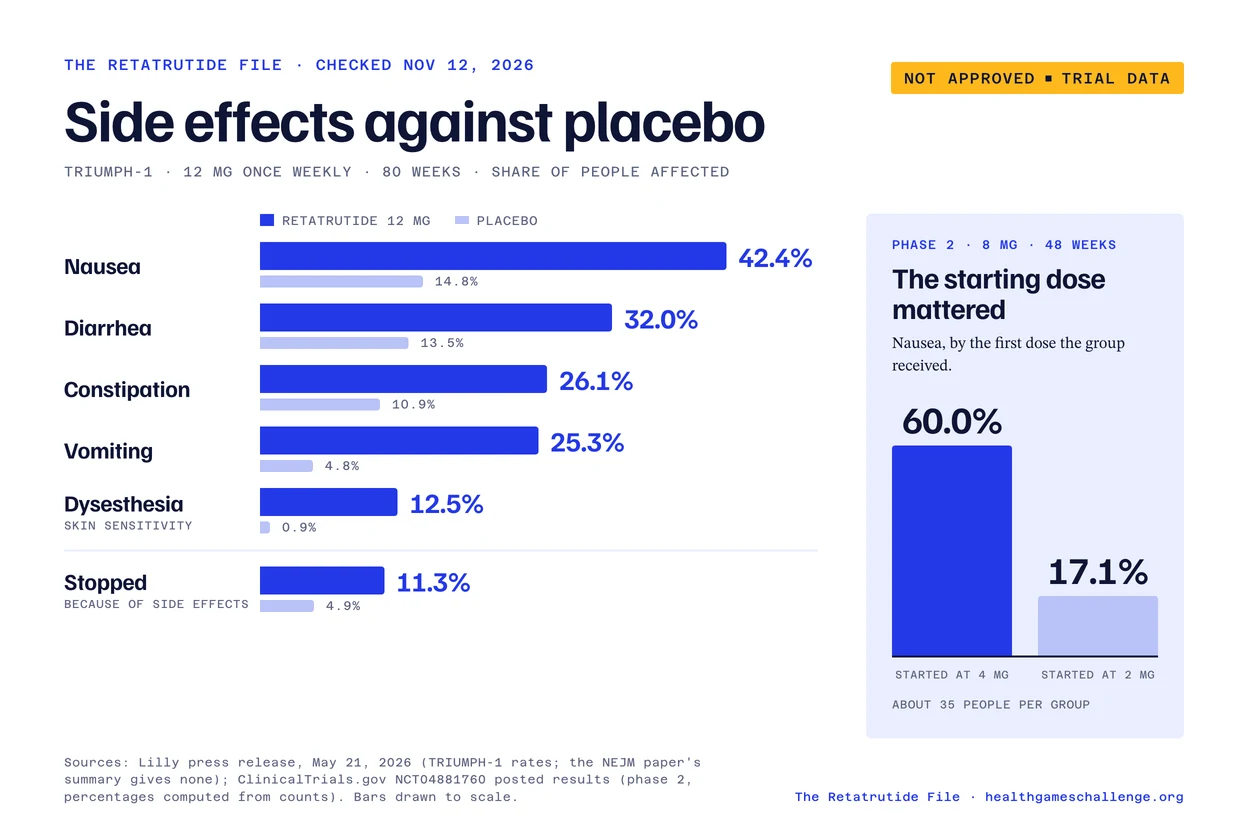
Retatrutide side effects are known only from clinical trials, because retatrutide is not approved by the FDA or any other regulator [Lilly, Oct 2026]. The most common ones are digestive: nausea, diarrhea, vomiting and constipation. They were more frequent at higher doses and mostly mild to moderate. Two other signals stand out: a skin sensitivity called dysesthesia, and a rise in heart rate seen in the phase 2 trial.
This page sets out how often each problem appeared, trial by trial and dose by dose, beside placebo. Every figure carries its source and says whether it comes from a peer-reviewed paper or a Lilly press release. Where the sources say nothing, we say that too.
What are the most common retatrutide side effects?
The largest trial so far is TRIUMPH-1: 2,339 adults with obesity and no diabetes, treated for 80 weeks. Its peer-reviewed paper sums up the safety picture in one line: The most common adverse events were gastrointestinal.
[NEJM, Sep 29, 2026] The paper's summary gives no rates. Lilly's press release does, and these are the figures below [Lilly, May 21, 2026].
| TRIUMPH-1, 80 weeks | 4 mg | 9 mg | 12 mg | Placebo |
|---|---|---|---|---|
| Nausea | 28.6% | 38.4% | 42.4% | 14.8% |
| Diarrhea | 25.2% | 34.1% | 32.0% | 13.5% |
| Constipation | 23.8% | 25.9% | 26.1% | 10.9% |
| Vomiting | 10.6% | 22.8% | 25.3% | 4.8% |
| Dysesthesia (skin sensitivity) | 5.1% | 12.3% | 12.5% | 0.9% |
| Urinary tract infection | 7.5% | 8.8% | 8.4% | 5.3% |
| Stopped because of side effects | 4.1% | 6.9% | 11.3% | 4.9% |
Source: company press release [Lilly, May 21, 2026]. The summary of the peer-reviewed paper doesn't list these rates.
Two things are worth noticing. Some people on placebo also reported nausea, so only the gap between the columns points to the drug. And most rates climb with the dose. In the phase 2 trial, the authors described the gut problems as dose-related
and mostly mild to moderate in severity
[NEJM, 2023].
How common is retatrutide nausea across the trials?
Every trial found the same pattern, though the size of it varied. The table shows the highest dose tested, 12 mg once a week, in each phase 3 trial that has reported. The trials enrolled different people for different lengths of time, so the rows can't be ranked against one another. Each cell gives retatrutide 12 mg first, then the comparison group.
| Trial (who, length) | Nausea | Diarrhea | Vomiting | Constipation | Source type |
|---|---|---|---|---|---|
| TRIUMPH-1 (obesity, 80 weeks) | 42.4% vs 14.8% | 32.0% vs 13.5% | 25.3% vs 4.8% | 26.1% vs 10.9% | Press release [Lilly, May 21, 2026] |
| TRIUMPH-4 (obesity and knee arthritis, 68 weeks) | 43.2% vs 10.7% | 33.1% vs 13.4% | 20.9% vs 0.0% | 25.0% vs 8.7% | Press release [Lilly, Dec 11, 2025] |
| TRIUMPH-2 (obesity and type 2 diabetes, 80 weeks) | 28.0% vs 8.0% | 33.6% vs 13.2% | 15.7% vs 4.2% | 16.8% vs 9.4% | Press release [Lilly, Jul 23, 2026] |
| TRIUMPH-3 (severe obesity and heart disease, 80 weeks) | 22.4% vs 5.8% | 24.4% vs 8.7% | Not given | 15.7% vs 7.1% | Press release [Lilly, Jul 23, 2026] |
| TRANSCEND-T2D-1 (type 2 diabetes, 40 weeks) | 26.5% vs 3.7% | 22.8% vs 4.5% | 17.6% vs 2.2% | Not given | Press release [Lilly, Mar 19, 2026] |
| TRANSCEND-T2D-2 (type 2 diabetes, 80 weeks, open label; compared with semaglutide 2 mg, not placebo) | 23.8% vs 21.3% | 32.7% vs 26.4% | 15.0% vs 13.2% | 13.1% vs 19.8% | Press release [Lilly, Oct 28, 2026] |
The TRIUMPH-2 paper in The Lancet gives the same figures, rounded. Nausea affected 28% on 12 mg against 8% on placebo, and diarrhea 34% against 13% [Lancet, Sep 29, 2026]. In TRANSCEND-T2D-1, Lilly said the gut problems occurred primarily during dose escalation
[Lilly, Mar 19, 2026], and the Lancet paper says they subsided over time
[Lancet, Jun 6, 2026].
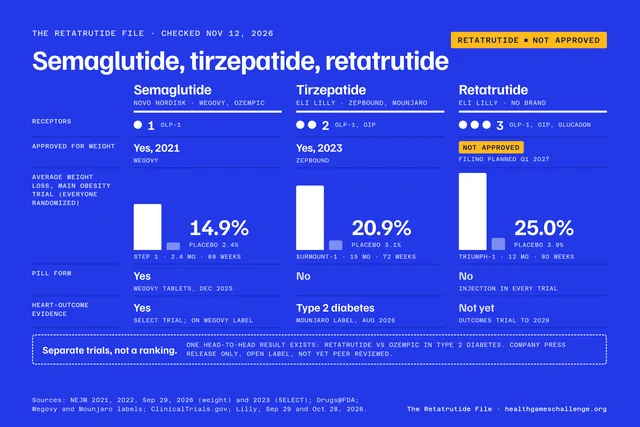
The last row is the only head-to-head result. Against Ozempic's top dose, nausea rates were close, and constipation was less common on retatrutide. That result comes from a press release about an open-label trial, where everyone knew which drug they were taking [Lilly, Oct 28, 2026].
Does the starting dose make a difference?
Yes, in the one trial that tested it. The phase 2 obesity trial started some groups on 2 mg and others on 4 mg. Its paper says the gut problems were partially mitigated with a lower starting dose (2 mg vs. 4 mg)
[NEJM, 2023]. The registry's posted counts show how large the gap was [ClinicalTrials.gov, NCT04881760]:
- 8 mg groups: nausea in 60.0% when the first dose was 4 mg, and 17.1% when it was 2 mg. Vomiting: 25.7% against 5.7%.
- 4 mg groups: nausea in 36.4% when the trial started at 4 mg, and 18.2% when it started at 2 mg.
- Placebo: nausea in 11.4%.
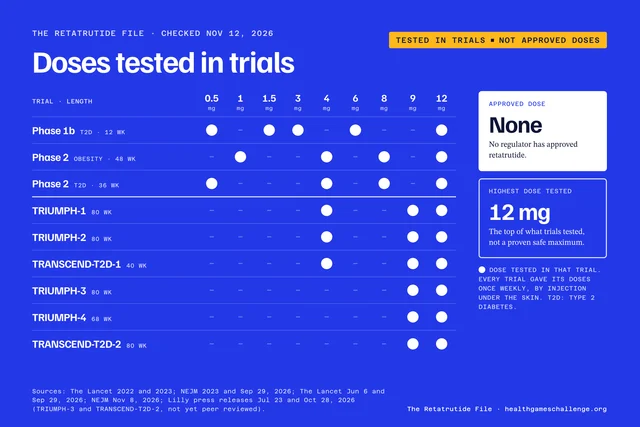
The groups were small, about 35 people each, so treat these as rough. Every phase 3 trial then started at 2 mg and raised the dose in steps. The doses and steps each trial used are set out in retatrutide dosage in trials, which reports what was tested and is not a guide to taking anything.
What is retatrutide skin sensitivity (dysesthesia)?
Dysesthesia means an abnormal feeling in the skin: tingling, burning, or pain from a touch that shouldn't hurt. The phase 2 registry recorded it under several names, including allodynia and sensitive skin
[ClinicalTrials.gov, NCT04881760]. In phase 3 it turned up in every trial, more often on retatrutide than on the comparison:
- TRIUMPH-4: 20.9% on 12 mg and 8.8% on 9 mg, compared with 0.7% on placebo [Lilly, Dec 11, 2025]
- TRIUMPH-1: 12.5% on 12 mg, compared with 0.9% on placebo [Lilly, May 21, 2026]
- TRIUMPH-2: 7% on 12 mg, compared with 1% on placebo (Lancet) [Lancet, Sep 29, 2026]
- TRIUMPH-3: 6.4% on 12 mg, compared with 1.3% on placebo [Lilly, Jul 23, 2026]
- TRANSCEND-T2D-2: 6.5% on 12 mg, compared with 2.7% on semaglutide [Lilly, Oct 28, 2026]
- TRANSCEND-T2D-1: 4.4% on 12 mg, compared with 0.0% on placebo [Lilly, Mar 19, 2026]
What did Lilly say about it? For TRIUMPH-1, that these events were generally mild to moderate, the majority resolved during treatment, and most participants continued taking retatrutide
[Lilly, May 21, 2026]. For TRIUMPH-4, that they rarely led to treatment discontinuation
[Lilly, Dec 11, 2025]. No source we read explains why it happens.
Does retatrutide raise heart rate?
It did in the phase 2 trial. The paper puts it in one sentence: Dose-dependent increases in heart rate peaked at 24 weeks and declined thereafter.
[NEJM, 2023] The summary doesn't give the size of the rise in beats per minute, and we found no primary source that does. Figures quoted on other websites disagree, so we don't repeat them.
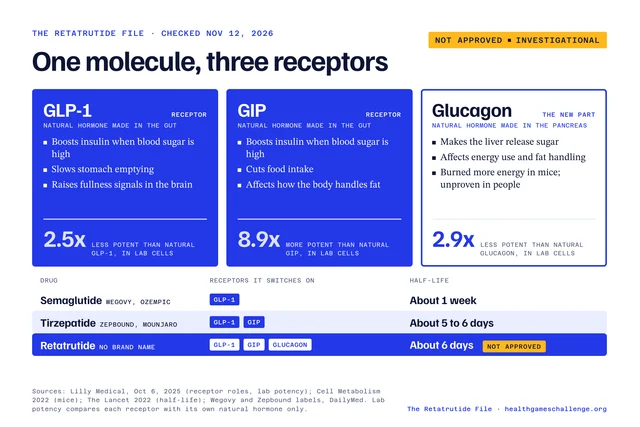
No phase 3 heart-rate figure had been released as of Nov 12, 2026. For scale, the approved drugs also raise it a little. The Zepbound label reports a mean rise of 1 to 3 beats per minute [FDA label, Aug 2026], and the Wegovy label 1 to 4 [FDA label, Jun 2026]. Why the glucagon part of retatrutide draws extra attention is covered in how retatrutide works.
How many people stopped because of side effects?
Dropout rates are a useful check, because they show who found the side effects hard enough to quit. In most trials, more people stopped on retatrutide than on placebo, and more on 12 mg than on lower doses.
| Trial | 4 mg | 9 mg | 12 mg | Comparison | Source type |
|---|---|---|---|---|---|
| TRIUMPH-1 | 4.1% | 6.9% | 11.3% | Placebo 4.9% | Press release [Lilly, May 21, 2026] |
| TRIUMPH-2 | 4% | 12% | 8% | Placebo 5% | Peer-reviewed paper [Lancet, Sep 29, 2026] |
| TRIUMPH-3 | Not tested | 9.8% | 13.5% | Placebo 4.8% | Press release [Lilly, Jul 23, 2026] |
| TRIUMPH-4 | Not tested | 12.2% | 18.2% | Placebo 4.0% | Press release [Lilly, Dec 11, 2025] |
| TRANSCEND-T2D-1 | 2.2% | 4.5% | 5.1% | Placebo 0.0% | Press release [Lilly, Mar 19, 2026] |
| TRANSCEND-T2D-2 | Not tested | 4.8% | 7.9% | Semaglutide 2 mg 2.7% | Press release [Lilly, Oct 28, 2026] |
The TRIUMPH-2 row counts people who stopped for side effects or died [Lancet, Sep 29, 2026]. TRIUMPH-4 had the highest rates, and Lilly said they included discontinuations for perceived excessive weight loss
. Among people who started with a BMI of 35 or more, the rates were 8.8% and 12.1%, compared with 4.8% on placebo [Lilly, Dec 11, 2025].
What serious side effects have been reported?
The knee osteoarthritis paper is the plainest: In both trials, serious adverse events were more common with retatrutide than with placebo
[NEJM, Nov 8, 2026]. Its summary gives no rates, and Lilly's releases don't either. Here is what the sources we could read do report:
- Deaths. In TRIUMPH-2, seven people died: six across the retatrutide groups and one on placebo. The investigators judged all of them unrelated to the drug [Lancet, Sep 29, 2026]. TRANSCEND-T2D-1 had two deaths, both on 4 mg and unrelated to the drug [Lancet, Jun 6, 2026].
- Low blood pressure. In TRIUMPH-2, hypotension affected 6% on 12 mg, compared with under 1% on placebo [Lancet, Sep 29, 2026].
- Low blood sugar. Neither the phase 2 diabetes trial nor TRANSCEND-T2D-1 reported any severe hypoglycemia [Lancet, 2023] [Lancet, Jun 6, 2026].
- Phase 2 serious events. In the obesity trial, the registry lists one case each of acute pancreatitis, acute gallbladder inflammation and heart failure on retatrutide. It also lists a prolonged QT interval, a heart-tracing finding, among others. It does not say whether the drug caused them [ClinicalTrials.gov, NCT04881760].
Retatrutide risks people search for: hair loss, blindness, cancer and more
People often ask about these risks. For each one, here is what the retatrutide sources say, and where they say nothing.
Hair loss
No retatrutide trial source we found reports a hair-loss rate. It isn't in the press releases, the paper summaries or the phase 2 results posted on the registry. The approved drug Zepbound does list it: 5% on its 15 mg dose against 1% on placebo, linked in the label to weight loss [FDA label, Aug 2026]. In the study of Reddit posts below, 0.6% of users who described side effects mentioned hair loss [JAMA Netw Open, Oct 2026]. That is not a rate for the drug.
Blindness (NAION)
The concern here comes from semaglutide, not retatrutide. NAION is an eye condition of the optic nerve that may cause loss of vision. In 2025, Europe's drug regulator concluded it is a very rare side effect of semaglutide
, affecting up to 1 in 10,000 users [EMA, Jun 6, 2025]. No retatrutide source we found mentions NAION or any eye result. That means not reported, not ruled out.
Cancer and thyroid tumors
Approved drugs in this family carry a boxed warning, because they caused thyroid C-cell tumors in rodents. Both the Zepbound and Wegovy labels carry it [FDA label, Aug 2026] [FDA label, Jun 2026]. Retatrutide has no label yet. TRIUMPH-1 kept out people with a personal or family history of medullary thyroid cancer or MEN-2, a gene condition linked to it [ClinicalTrials.gov, NCT05929066]. A few cancers appear among serious events in the small phase 2 trials, such as one kidney cancer and one melanoma. The registry doesn't say whether the drug played a part [ClinicalTrials.gov, NCT04881760] [ClinicalTrials.gov, NCT04867785]. The trials so far are too short to judge cancer risk.
Gallbladder and pancreatitis
Both are known risks of the approved drugs; the Zepbound label lists acute gallbladder disease and pancreatitis among its warnings [FDA label, Aug 2026]. For retatrutide, the phase 2 trials recorded three cases of acute pancreatitis and two of gallbladder inflammation across both trials [ClinicalTrials.gov, NCT04881760] [ClinicalTrials.gov, NCT04867785]. TRIUMPH-1 excluded people who had ever had pancreatitis [ClinicalTrials.gov, NCT05929066]. Across the phase 3 program, suspected cases go to a central review panel [DOM, Oct 15, 2025]. No phase 3 rate has been released.
Mood and suicidal thoughts
No retatrutide trial source we found reports rates of depression or suicidal thoughts. For the approved drugs, the Zepbound and Wegovy labels both mark their suicidal behavior and ideation warning as removed in February 2026 [FDA label, Aug 2026] [FDA label, Jun 2026].
Is retatrutide safe? What the trials can and can't tell you
"Safe" is not a word any regulator has used for retatrutide. The TRIUMPH-2 authors describe its safety profile as generally consistent with other molecules with GLP-1 receptor agonism
[Lancet, Sep 29, 2026]. That is a judgment from 80 weeks of data in carefully screened volunteers. Outcomes such as heart attacks and strokes are being tested in a trial of about 10,000 people, with main results expected in 2029 [ClinicalTrials.gov, NCT06383390]. Until then, no one knows the long-term risks.
Why products sold online carry different and extra risks
Everything above describes Lilly's trial drug, given at measured doses under medical watch. What's sold online as retatrutide is a different thing. The FDA says sellers have marketed it with labels such as "for research purposes" while selling it directly to consumers for human use with dosing instructions
[FDA, Oct 1, 2026]. Lilly warns that such products may also have too much or too little active ingredient, or the wrong ingredient entirely
[Lilly, Oct 2026].
Regulators have found exactly that. In Australia, the TGA tested a vial sold as retatrutide after a buyer was hospitalized with a torn esophagus from uncontrollable vomiting. It held undeclared semaglutide and no retatrutide
, at about 8 times the level in approved semaglutide products [TGA, Sep 14, 2026]. The Victorian health department has linked six cases of acute liver injury to products labeled retatrutide. It says the harm is possibly associated with a contaminant
[Victoria Health, Jun 19, 2026].
You may also see side-effect lists drawn from online posts. A 2026 study read Reddit posts from 13,589 people who said they used retatrutide. Its authors warn that product identity, purity, dose, route, treatment duration, concomitant medications, and medical history cannot be verified
[JAMA Netw Open, Oct 2026]. Posts like these can't tell you how often a side effect happens. What the online listings are, and why no one can legally sell them, is covered in retatrutide for sale. For the trial basics, start with what is retatrutide.
Sources
- [Lilly, Oct 2026] What to know about retatrutide. Eli Lilly and Company (page marked last updated October 2026), Oct 2026. Company page. Checked Nov 12, 2026
- [Lilly, May 21, 2026] Lilly's triple agonist, retatrutide, delivered powerful weight loss in pivotal Phase 3 obesity trial. Eli Lilly and Company press release, PR Newswire copy (investor.lilly.com blocks automated reading), May 21, 2026. Company press release. Checked Nov 12, 2026
- [NEJM, Sep 29, 2026] Retatrutide, a Triple Hormone Receptor Agonist, for Treatment of Obesity (TRIUMPH-1). New England Journal of Medicine (Jastreboff AM et al.), print issue Nov 5, 2026, Sep 29, 2026. Peer-reviewed paper. Abstract read on PubMed. Checked Nov 12, 2026
- [Lancet, Sep 29, 2026] Retatrutide in adults with obesity and type 2 diabetes (TRIUMPH-2): a double-blind, parallel-group, randomised, placebo-controlled, phase 3 trial. The Lancet (Bellido V et al.), Sep 29, 2026. Peer-reviewed paper. Abstract read on PubMed. Checked Nov 12, 2026
- [Lilly, Jul 23, 2026] Lilly's triple agonist, retatrutide, successful in two additional Phase 3 obesity trials, delivering significant improvements in weight and A1C. Eli Lilly and Company press release, PR Newswire copy, Jul 23, 2026. Company press release. Checked Nov 12, 2026
- [Lilly, Dec 11, 2025] Lilly's triple agonist, retatrutide, delivered weight loss of up to an average of 71.2 lbs along with substantial relief from osteoarthritis pain in first successful Phase 3 trial. Eli Lilly and Company press release, PR Newswire copy, Dec 11, 2025. Company press release. Checked Nov 12, 2026
- [NEJM, Nov 8, 2026] Retatrutide Once Weekly in Adults with Knee Osteoarthritis Pain and Obesity (TRIUMPH-4 and TRIUMPH-1-OA). New England Journal of Medicine (Schnitzer TJ et al.), online ahead of print, Nov 8, 2026. Peer-reviewed paper. Abstract read on PubMed. Checked Nov 12, 2026
- [Lilly, Mar 19, 2026] Lilly's triple agonist, retatrutide, demonstrated significant reductions in A1C and weight in first Phase 3 trial for treatment of type 2 diabetes. Eli Lilly and Company press release, PR Newswire copy, Mar 19, 2026. Company press release. Checked Nov 12, 2026
- [Lancet, Jun 6, 2026] Efficacy and safety of retatrutide, a GIP, GLP-1, and glucagon receptor agonist, in people with type 2 diabetes and inadequate glycaemic control with diet and exercise (TRANSCEND-T2D-1): a double-blind, randomised, phase 3 trial. The Lancet (Bajaj HS et al.), Jun 6, 2026. Peer-reviewed paper. Abstract read on PubMed. Checked Nov 12, 2026
- [Lilly, Oct 28, 2026] Lilly's retatrutide delivered greater A1C reduction and more than double the weight loss of Ozempic's highest approved dose in head-to-head trial. Eli Lilly and Company press release, PR Newswire, Oct 28, 2026. Company press release. Checked Nov 12, 2026
- [NEJM, 2023] Triple-Hormone-Receptor Agonist Retatrutide for Obesity: A Phase 2 Trial. New England Journal of Medicine (Jastreboff AM et al.), Jun 26, 2023. Peer-reviewed paper. Abstract read on PubMed. Checked Nov 12, 2026
- [ClinicalTrials.gov, NCT04881760] A Study of LY3437943 in Participants Who Have Obesity or Are Overweight (phase 2), posted results. ClinicalTrials.gov, sponsor Eli Lilly and Company (record updated Sep 13, 2023), Sep 13, 2023. Trial registry record with posted results. Percentages on this page are computed by us from the posted counts of people affected and people at risk, up to 52 weeks. Checked Nov 12, 2026
- [Lancet, 2023] Retatrutide, a GIP, GLP-1 and glucagon receptor agonist, for people with type 2 diabetes: a randomised, double-blind, placebo and active-controlled, parallel-group, phase 2 trial conducted in the USA. The Lancet (Rosenstock J et al.), Jun 26, 2023. Peer-reviewed paper. Abstract read on PubMed. Checked Nov 12, 2026
- [ClinicalTrials.gov, NCT04867785] A Study of LY3437943 in Participants With Type 2 Diabetes (phase 2), posted results. ClinicalTrials.gov, sponsor Eli Lilly and Company (record updated Jul 3, 2023), Jul 3, 2023. Trial registry record with posted results. Checked Nov 12, 2026
- [ClinicalTrials.gov, NCT05929066] A Study of Retatrutide (LY3437943) in Participants Who Have Obesity or Overweight (TRIUMPH-1). ClinicalTrials.gov, sponsor Eli Lilly and Company (record updated Aug 21, 2026), Aug 21, 2026. Trial registry record. Eligibility criteria. Checked Nov 12, 2026
- [DOM, Oct 15, 2025] Retatrutide for the treatment of obesity, obstructive sleep apnea and knee osteoarthritis: Rationale and design of the TRIUMPH registrational clinical trials. Diabetes, Obesity and Metabolism (Giblin K et al.), Oct 15, 2025. Peer-reviewed paper (trial design). Open-access full text on PubMed Central. Checked Nov 12, 2026
- [ClinicalTrials.gov, NCT06383390] The Effect of Retatrutide Once Weekly on Cardiovascular Outcomes and Kidney Outcomes in Adults Living With Obesity. ClinicalTrials.gov, sponsor Eli Lilly and Company (record updated Oct 8, 2026), Oct 8, 2026. Trial registry record. Checked Nov 12, 2026
- [FDA label, Aug 2026] ZEPBOUND (tirzepatide) injection, prescribing information. DailyMed, U.S. National Library of Medicine (FDA-approved label, effective Aug 28, 2026), Aug 28, 2026. Regulator (drug label). Checked Nov 12, 2026
- [FDA label, Jun 2026] WEGOVY (semaglutide) injection and tablets, prescribing information. DailyMed, U.S. National Library of Medicine (FDA-approved label, effective Jun 18, 2026), Jun 18, 2026. Regulator (drug label). Checked Nov 12, 2026
- [EMA, Jun 6, 2025] PRAC concludes eye condition NAION is a very rare side effect of semaglutide medicines Ozempic, Rybelsus and Wegovy. European Medicines Agency, Jun 6, 2025. Regulator. Checked Nov 12, 2026
- [JAMA Netw Open, Oct 2026] Self-Reported Adverse Effects Among Social Media Users Taking Nonapproved Retatrutide. JAMA Network Open (Sehgal NKR et al.), Oct 1, 2026. Peer-reviewed paper (analysis of social media posts). Open-access full text on PubMed Central. Checked Nov 12, 2026
- [FDA, Oct 1, 2026] FDA's Concerns with Unapproved GLP-1 Drugs Used for Weight Loss. U.S. Food and Drug Administration (content current as of Oct 1, 2026), Oct 1, 2026. Regulator. Checked Nov 12, 2026
- [TGA, Sep 14, 2026] TGA tests counterfeit retatrutide product following serious adverse event report. Therapeutic Goods Administration, Australia, Sep 14, 2026. Regulator. tga.gov.au timed out on Nov 12, 2026; read from the Internet Archive copy captured Sep 21, 2026. Checked Nov 12, 2026
- [Victoria Health, Jun 19, 2026] Toxicity linked to unapproved peptide product labelled Retatrutide. Department of Health, Victoria, Australia (health alert, status active), Jun 19, 2026. Regulator (state health department). Checked Nov 12, 2026
Changes to this page
- Published. Trial side-effect figures, regulator alerts and sources checked on this date.
Related guides
Safety
 Retatrutide dosage in trials
Basics
 How retatrutide works
Comparison
 Retatrutide vs semaglutide